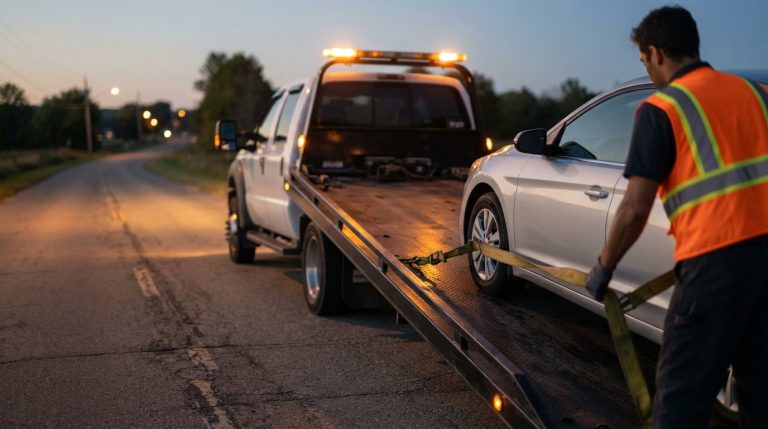
An off-road recovery provider needs accurate information about the vehicle, location, terrain, and surrounding hazards before responding. These details help the towing team select appropriate equipment, find the stranded driver, and plan a safer recovery approach.
Off-road recovery differs from routine towing because the disabled vehicle may be far from pavement, positioned on unstable ground, or difficult for a tow truck to reach. Providing complete information during the initial call can reduce confusion once help arrives.
What Vehicle Information Should the Driver Provide?
The towing dispatcher should know the vehicle’s year, make, model, and general type. A compact car stuck on a dirt shoulder presents different recovery needs than a pickup truck, work van, motorcycle, or recreational vehicle.
Drivers should also explain whether the vehicle is loaded or carrying unusually heavy equipment. Added weight can affect the amount of pulling force required and how the vehicle responds during recovery.
Useful vehicle details include:
- Whether the vehicle is two-wheel drive, four-wheel drive, or all-wheel drive
- Its approximate size and weight, if known
- The number of passengers
- Whether a trailer is attached
- Any cargo or equipment affecting its weight
- Visible modifications, such as a lift kit or lowered suspension
The provider may also ask whether the steering works and whether the transmission can shift into neutral. Drivers should answer based only on what they can safely confirm.
How Can a Driver Share an Accurate Location?
An accurate location is critical in desert and off-road areas around Apache Junction, AZ. A street address may not exist, and verbal descriptions such as “near the trail” may apply to several different places.
A smartphone map pin or GPS coordinates can provide a more precise location. Drivers should also identify the road, trail, parking area, gate, mile marker, or recognizable landmark they passed before becoming stuck.
If the vehicle is in an area with limited cellular service, the driver should avoid ending the call until the dispatcher confirms the location. They should also explain whether their phone battery is low or communication may be lost.
When possible, drivers can describe their route from the nearest paved road. Information about turns, gates, forks, and changes in road conditions can help the towing service determine how to approach the site.
Why Does the Type of Terrain Matter?
Terrain affects traction, equipment placement, and the direction in which a vehicle can be recovered. Sand, mud, loose gravel, rocks, washes, and steep slopes create different challenges.
A driver should describe what is beneath and around the vehicle. For example, a car with its tires lightly buried in dry sand may require a different response than a truck resting on its frame in a soft wash.
Recent weather should also be mentioned. Rain can soften desert roads, create hidden erosion, and make dry washes unsafe. Ground that appears stable near the vehicle may not support the weight of recovery equipment.
Clear terrain details help the towing company evaluate access before arriving. Southeast Towing and Recovery LLC provides towing and roadside assistance in Apache Junction and nearby communities, and they can use this information to better understand the recovery conditions.
What Is the Vehicle’s Current Position?
The vehicle’s exact position can reveal whether there is a risk of sliding, tipping, or sustaining further damage. Drivers should explain if the vehicle is level, leaning, angled across a trail, or close to an embankment.
They should also report whether:
- One or more wheels are off the ground
- The tires are deeply buried
- The frame or underbody is touching the ground
- The vehicle is in a ditch or wash
- The front or rear is facing downhill
- A wheel is damaged or turned at an unusual angle
- The vehicle is close to rocks, trees, fencing, or structures
Drivers should not crawl beneath the vehicle to inspect it. Sand and loose terrain can shift, causing the vehicle to settle unexpectedly.
What Mechanical Problems Should Be Reported?
A vehicle may become stranded because of more than poor traction. Mechanical failure, collision damage, overheating, or a flat tire can affect how the recovery must be performed.
The towing provider should know if the engine runs, the brakes respond, the wheels roll, or fluid is leaking. Smoke, fuel odors, damaged batteries, or exposed electrical components should be reported immediately.
If the vehicle was involved in a collision, the driver should describe visible damage without attempting to move loose parts. Damaged steering or suspension components may prevent the vehicle from rolling normally after it is pulled onto firm ground.
What Access Limitations Should Be Mentioned?
A tow truck must be able to reach a stable position near enough to perform the recovery. Narrow trails, low tree branches, locked gates, deep ruts, sharp turns, or limited turnaround space may affect access.
Drivers should mention whether other vehicles have reached the area and whether a large service vehicle can approach safely. They should not assume that a path suitable for a passenger vehicle can also support towing equipment.
If a gate requires a code, key, permit, or property-owner approval, that information should be addressed before the operator arrives. This can prevent delays and unnecessary travel.
Should Drivers Send Photos or Video?
Photos can help clarify terrain, vehicle position, and access conditions when the provider accepts them. Useful images may show the entire vehicle, buried wheels, the surrounding ground, the approach route, and nearby hazards.
Drivers should take photos only from a safe position. They should not climb unstable slopes, stand downhill from the vehicle, or enter an active roadway to obtain a better angle.
A short video may also show the width and condition of the access route. Visual information supplements the phone description but does not replace an on-site safety assessment.
Why Is 24/7 Towing Service Helpful Off Road?
Off-road incidents do not always occur during regular business hours. A 24/7 towing service gives drivers a contact option when a vehicle becomes disabled at night, early in the morning, or over the weekend.
However, darkness and weather may affect how quickly a recovery can be evaluated or performed. The towing team must consider visibility, ground stability, and safe equipment placement before beginning any pull.
Request Off-Road Recovery With Clear Information
Before requesting help, gather the vehicle description, map pin, terrain conditions, access limitations, and visible damage. Share these details clearly with the towing provider, follow their safety instructions, and avoid further attempts to move the vehicle if doing so could make the situation worse.